Which World Cup Nations Can You Spell With the Periodic Table?
Why You Can't Cleanly Spell GOAL With the Periodic Table (And How We Did It Anyway)
The most important word in football cannot be cleanly spelled with the periodic table.
GOAL. Four letters, and the periodic table trips on the first one. There is no single-letter G element, and no two-letter element Go. Start with Ga-O and you strand the L. Start with gallium's neighbours and you strand the G. Line up every one of the 118 element symbols and there is no way to build G-O-A-L where each letter sits inside a fully-formed symbol.
Which is a strange thing for a chemistry app to admit up front. So hold that thought — we come back to GOAL at the very end, and there is a trick.
Because almost everything else about the World Cup does spell. The words. The nations. And the tournament isn't just spellable in element symbols — it is physically built from elements. The trophy is gold standing on copper ore. The ball is a polymer sandwich with a lithium-powered sensor inside. The pitch lines are painted with the same white pigment as your sunscreen. The players run on sodium, potassium and magnesium.
This is the chemistry of the World Cup, in two halves: what the tournament spells, and what the tournament is made of.
The Words That Spell Perfectly
These are "clean" spellings — every letter carried by a fully-emphasized element symbol, no tricks. Try any of them in the Spell tool.
| Word | Element spelling | |
|---|---|---|
| SOCCER | S-O-C-C-Er | Sulfur, oxygen, carbon, carbon, erbium |
| CHAMPION | C-H-Am-P-I-O-N | The best of the set |
| CHAMPIONS | C-H-Am-P-I-O-N-S | |
| CAPTAIN | Ca-P-Ta-I-N | Calcium, phosphorus, tantalum, iodine, nitrogen |
| PITCH | P-I-Tc-H | Tc is technetium — the first synthetic element |
| TEAM | Te-Am | Two elements. Tellurium and americium. |
| FINAL | F-I-N-Al | |
| WINNER | W-I-N-N-Er | |
| CUP | C-U-P | Carbon, uranium, phosphorus |
SOCCER is the money word — S-O-C-C-Er, ending on erbium, and we'll come back to that erbium in a moment because it turns out to be the hardest-working element in the whole sport.
Match-day vocabulary
The commentary spells too. SCORE (S-C-O-Re), CORNER (C-O-Rn-Er), CROSS (Cr-O-S-S), SCREAMER (S-C-Re-Am-Er), POSSESSION (P-O-S-Se-S-S-I-O-N), TACTICS (Ta-C-Ti-C-S), CLINICAL (Cl-I-N-I-C-Al), PLAYER (P-La-Y-Er), COACH (C-O-Ac-H), and BOOTS (B-O-O-Ts).
Fan culture
So does everything in the stands. FLAG (Fl-Ag), SCARF (S-C-Ar-F), TIFO (Ti-F-O), BANNER (Ba-N-N-Er), SAMBA (S-Am-Ba), FIESTA (F-I-Es-Ta), PASSION (Pa-S-S-I-O-N), HERO (H-Er-O), and — yes — SIUUU (Si-U-U-U). It reads like a joke. It genuinely spells. It will get shared.
Phrases that hold together end to end
Because the tool handles phrases, whole chants spell:
- ONE TEAM — O-Ne / Te-Am
- ONE NATION ONE TEAM — O-Ne / N-At-I-O-N / O-Ne / Te-Am
- NO PAIN NO GAIN — N-O / Pa-I-N / N-O / Ga-I-N
- SOCCER PLAYER — S-O-C-C-Er / P-La-Y-Er
- PITCH INVASION — P-I-Tc-H / I-N-V-As-I-O-N
The Nations: Chemistry Has Opinions
Here is where it gets interesting, because chemistry does not respect the FIFA rankings.
These spell cleanly:
| Country | Element spelling |
|---|---|
| ARGENTINA | Ar-Ge-N-Ti-Na |
| NETHERLANDS | Ne-Th-Er-La-Nd-S |
| FRANCE | F-Ra-N-Ce |
| SPAIN | S-Pa-I-N |
| POLAND | P-O-La-Nd |
| PERU | P-Er-U |
| WALES | W-Al-Es |
| CUBA | C-U-Ba |
Two of the sport's aristocracy — ARGENTINA and the NETHERLANDS — spell perfectly, every letter a full symbol. Argentina reads like it was designed for it: Argon, Germanium, nitrogen, Titanium, Na for sodium.
And then the surprise. BRAZIL, GERMANY, ITALY, ENGLAND and PORTUGAL do not spell cleanly. Neither do the three 2026 hosts — CANADA, MEXICO, or USA. The five-time champions and the tournament's own hosts get left out, while Peru and Wales sail through. Chemistry has strong opinions about football, and they are not the popular ones.
That "not cleanly" is doing quiet work in that last paragraph, and it's the whole game. Hold onto it.
Erbium: The MVP of Football
Count the element symbols doing the heavy lifting across all that football vocabulary and one name keeps surfacing — and it is not one you'd guess.
It's **erbium**. Symbol Er, atomic number 68, a rare-earth metal almost nobody outside a chemistry department can name. It ends SOCC-Er, WINN-Er, PLAY-Er, CORN-Er, SCREAM-Er, BANN-Er, POW-Er, SILV-Er, and it carries the middle of H-Er-O. No other element shows up as often in the language of the game. Erbium is the MVP of football, and it has never touched a ball.
There's a second element worth calling out, for a different reason. **Titanium** (Ti) turns up all over the vocabulary — TACTICS, ACTION, REACTION, MOTIVATION, TIFO. And titanium is also physically painted onto the pitch, as titanium dioxide, in every white line on the field (more on that below). It's the cleanest bridge between the two halves of this story: the same element that spells the game is the one drawn under the players' feet.
What the World Cup Is Actually Made Of
The wordplay is the fun half. This is the half a chemistry teacher can build a lesson around.
The trophy — gold on copper ore
The FIFA World Cup Trophy looks like solid gold. It isn't — and it couldn't be. At roughly 36.8 cm tall and about 6.2 kg, it is hollow; a solid-gold version of that volume would be far too heavy to hoist over your head the way winners do.
- The figure is 18-carat gold — 75% gold (Au), the rest alloying metals for hardness. Pure gold is too soft to survive being lifted, dropped, and paraded.
- The base is two rings of malachite — a green copper carbonate hydroxide mineral. Its colour comes straight from copper(II) ions.
The most coveted object in sport is a gold alloy standing on a lump of copper ore.
The ball — a polymer sandwich with a battery inside
The 2026 match ball is a four-panel design, thermally bonded rather than stitched — fewer seams means less water uptake and a more predictable flight. Working from the outside in, it's a stack of layers: a polyurethane skin, a textured outer surface, a foam cushioning layer, and a butyl rubber bladder at the core.
That bladder is the best chemistry beat in the whole tournament. Why butyl and not latex? A latex bladder gives a livelier bounce, but it leaks — gas molecules diffuse straight through its loose polymer network. Butyl's tighter chain packing traps the air. That is diffusion through a polymer membrane, and it's why your ball still has air in it on Thursday. A ten-year-old owns the experiment.
And there's electronics inside. Connected-ball technology puts a 500 Hz motion sensor — a tiny inertial measurement unit, about 14 grams, built with Kinexon — inside one of the ball's four panels, sampling its motion 500 times a second and feeding real-time data to the video assistant referee for offside calls. So there is silicon and lithium inside a football now. The referee's assistant is a battery.
Vanishing spray
The white line a referee sprays for a free-kick wall is a foam of butane/propane propellant, water and a surfactant. It disappears within about a minute because the propellant evaporates and the foam collapses. Best "read this one out in class" fact in the article.
The pitch and the players
The chemistry keeps going right down into the grass:
- The white lines are titanium dioxide (TiO₂) — the same brilliant-white pigment in sunscreen, toothpaste and paper. It's spectacularly opaque, which is exactly what a line needs to be.
- The grass runs on N-P-K fertiliser: nitrogen for blades, phosphorus for roots, potassium for stress tolerance.
- The players sweat an electrolyte solution — sodium, potassium, magnesium, calcium. Sodium loss is what cramps you, which is why sports drinks are salted. Muscle contraction is a calcium-ion story, and every sprint is powered by ATP — adenosine tri-phosphate — so phosphorus is doing the work in every run.
There's a free pun here and you should take it: NATION spells as N-At-I-O-N, and the players are literally running on ions.
The formulas, for the record
| Thing | Material | Formula |
|---|---|---|
| Trophy base | Malachite (copper carbonate hydroxide) | Cu₂CO₃(OH)₂ |
| Pitch lines | Titanium dioxide | TiO₂ |
| Ball bladder | Butyl rubber (polyisobutylene) | (C₄H₈)ₙ |
| Trophy figure | 18-carat gold alloy | 75% Au |
The Twist: GOAL, Solved
Back to the word we started with. GOAL cannot be spelled cleanly — we established that up top. Every letter has to sit inside a full element symbol, and there is no clean path through G-O-A-L.
But look at germanium: Ge. Element 32. If you write Ge-O-Al and let the e in germanium fade — de-emphasize it, drop its visual weight toward invisible — the tiles read G-O-Al. The element is still germanium. Nothing chemical has changed. What changed is typographic weight: you chose which of germanium's two letters to foreground.
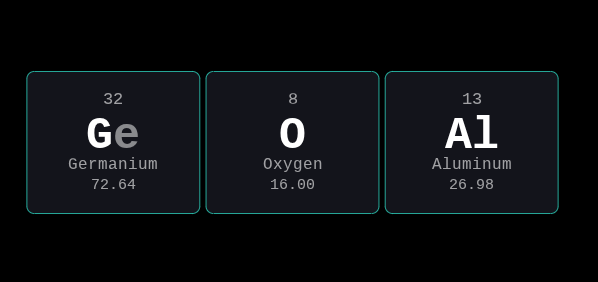
That's the point worth being precise about. We are not claiming Ge means G — it doesn't, and any chemist reading this would rightly object. The tile is germanium. You have simply chosen which of its two letters carries the emphasis. It's a design control, not a chemistry claim.
And it's a slider, not a switch. Leave the e faintly visible and the tile stays honestly germanium. Take the emphasis all the way down and the e disappears entirely, leaving a clean G on the tile — visual purity for anyone who wants GOAL to read as nothing but the word, chemical completeness traded for a crisp wordmark. The atomic number and the name printed on the tile still say germanium either way; all you've changed is how much of the symbol you show. That control — partial emphasis — is what lets the periodic table reach words the "clean" rules can't touch: GOAL, WORLD, GERMANY, BRAZIL, and most of the football words that looked impossible a few sections ago. It's also what sets Spellement apart: the other periodic-table tools — ChemSpeller and elementfinder.info among them — only surface whole symbols already sitting in your text, so GOAL stays out of reach for them.
Most of them.
The Wall: J and Q
Here is the genuinely surprising fact, the one worth screenshotting.
Across all 118 element symbols, every letter of the alphabet appears somewhere — as a first or second letter of some symbol — except two: J and Q. (We wrote a whole piece on the two letters the periodic table forgot.)
The consequence for football is sharp. With partial emphasis, Spellement can reach any word that doesn't contain a J or a Q. Which means:
Japan and Qatar are the only two footballing nations that can never be spelled with the periodic table — by any tool, under any settings, ever. Qatar hosted the last World Cup. Chemistry does not care.
It doesn't stop at nations. Permanently unspellable, no matter how you emphasize: JAMAICA, JORDAN, IRAQ, AZERBAIJAN — and, from the wider football vocabulary, JERSEY and QUARTERFINAL, the two words readers will test first. There is no workaround. J and Q simply are not in the box.
So the tournament that spells almost everything — the trophy, the ball, the chant, the champions — runs into exactly two dead ends, and they are both on the map.
Spell Your Own
Type your country. Type your club. Type your name, or your favourite player's, and watch the tiles fall into place — or hit the J/Q wall and find out you're one of the unspellable ones.
More element wordplay: the longest words you can spell with elements, 300 words hiding in the periodic table, and how Breaking Bad made element art famous.