Spring Has Arrived — And the Periodic Table Knows It
Spring doesn't just feel like a fresh start. Chemically, it is one. The elements that spent winter locked in frozen soil are suddenly back in circulation — nitrogen fixing into roots, phosphorus driving new growth, potassium regulating every cell that opens to the sun. The periodic table has been waiting for this all year.
And it turns out a surprising number of spring words spell beautifully with element symbols.
The Chemistry of Spring (It's All on the Table)
Three elements run the show every spring:
Nitrogen (N) — element 7. Chlorophyll, the molecule that makes leaves green, is built around nitrogen. When you see your lawn turn from brown to vivid green in April, you're watching nitrogen get back to work. Plants pull it from the soil, the soil pulls it from bacteria, and the cycle restarts every spring.
Phosphorus (P) — element 15. Root growth. Flower development. Seed formation. Phosphorus is the element behind every bulb that pushes through frozen ground in March. Without it, tulips would stay underground permanently.
Potassium (K) — element 19. Every time a plant opens its stomata (the tiny pores on leaves) to breathe in carbon dioxide, potassium is regulating that process. It controls water movement in and out of cells. Spring rain is only useful because potassium tells the plant what to do with it.
Those three elements — N, P, K — are the numbers on every bag of fertiliser you've ever seen. The periodic table has been telling gardeners what spring needs since 1869.
Spring Words the Periodic Table Can Spell
These words all spell cleanly with element symbols. Every one has been verified by the Spellement algorithm. An asterisk marks an element lending only one of its two letters — Ti* (Titanium) gives its T while the i is greyed out. Elements without one are used whole.
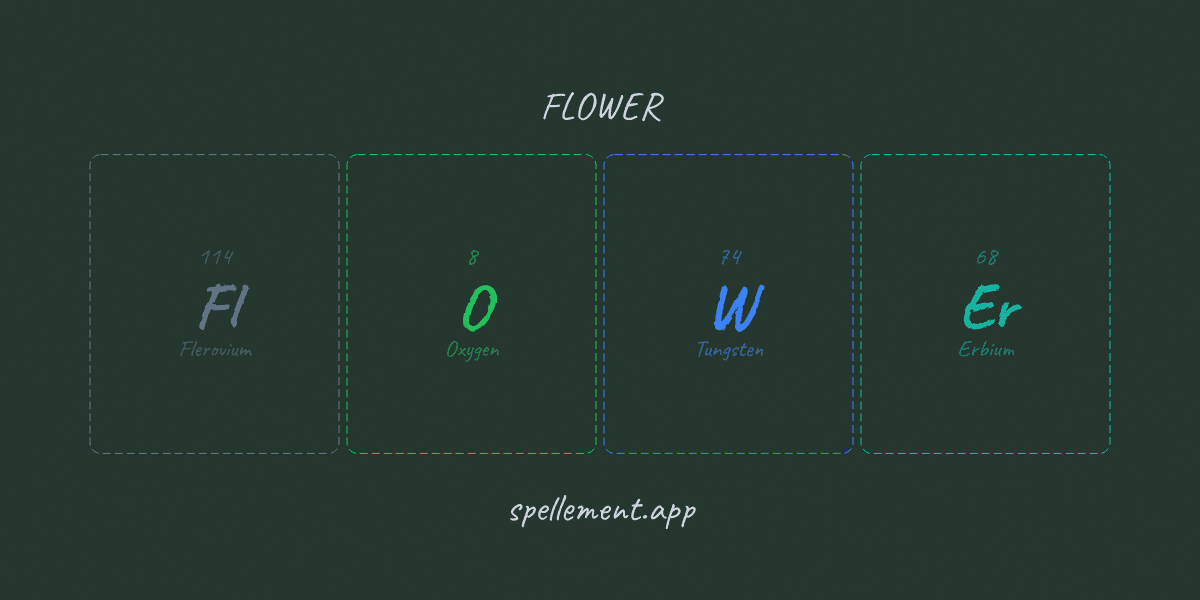
Flowers
- IRIS — Ir (Iridium) + I (Iodine) + S (Sulfur). A clean three-tile spelling for one of the first flowers to bloom in spring.
- ROSE — Rb* (Rubidium) + O (Oxygen) + Se (Selenium). Just three tiles. The periodic table keeps roses simple.
- LILY — Li (Lithium) + Li* (Lithium) + Y (Yttrium). Two Lithiums and an Yttrium — the first used whole, the second lending only its L. LILY uses element 3 twice, fitting for a flower that multiplies by bulb division.
- TULIP — Ti* (Titanium) + U (Uranium) + Li (Lithium) + P (Phosphorus). Phosphorus appears in the spelling of a flower that depends on it to push through frozen soil. The periodic table knows.
- CROCUS — Cr (Chromium) + O (Oxygen) + Cu (Copper) + S (Sulfur). Four elements, including Chromium — which gets its name from the Greek word for colour. Appropriate for one of the most colourful early spring flowers.
- PANSY — Pa (Protactinium) + N (Nitrogen) + S (Sulfur) + Y (Yttrium). Protactinium is one of the rarest elements in Earth's crust, and it opens one of the most common spring flowers.
Nature Words
- BLOOM — B (Boron) + Li* (Lithium) + O (Oxygen) + O (Oxygen) + Mo* (Molybdenum). Five tiles for the word that defines spring.
- SPROUT — S (Sulfur) + Pr (Praseodymium) + O (Oxygen) + U (Uranium) + Te* (Tellurium). Praseodymium — element 59, a rare earth metal — is hiding inside SPROUT.
- FERN — Fe (Iron) + Rn (Radon). Just two elements. Iron and Radon spell FERN with zero waste.
- MOSS — Mo (Molybdenum) + S (Sulfur) + S (Sulfur). Molybdenum, an essential micronutrient for plants, leads the spelling.
- BARK — Ba (Barium) + Rn* (Radon) + K (Potassium). Barium opens, Potassium closes.
- VINE — V (Vanadium) + I (Iodine) + Ne (Neon). Vanadium, Iodine, and Neon — a surprisingly elegant trio.
- NEST — Ne (Neon) + S (Sulfur) + Te* (Tellurium). Neon — the noble gas known for glowing signs — builds a NEST.
- WREN — W (Tungsten) + Re (Rhenium) + N (Nitrogen). Tungsten starts and Nitrogen finishes. WREN is a clean three-element word.
Weather and Season
- RAIN — Ra (Radium) + I (Iodine) + N (Nitrogen). Radium, the element Marie Curie discovered, starts every rainstorm.
- THAW — Th (Thorium) + As* (Arsenic) + W (Tungsten). Thorium — a radioactive metal — melts ice, at least linguistically.
- WARM — W (Tungsten) + Ar (Argon) + Mo* (Molybdenum). Tungsten and Argon — one of the densest metals and a noble gas — team up for WARM.
- FRESH — Fr (Francium) + Es (Einsteinium) + H (Hydrogen). Francium is the rarest naturally occurring element on Earth. Einsteinium was discovered in nuclear fallout. Together they spell FRESH. Chemistry has a sense of irony.
- SPRING — S (Sulfur) + Pr (Praseodymium) + I (Iodine) + N (Nitrogen) + Ge* (Germanium). The word itself works. SPRING is spellable.
Spring Words That Don't Work (and Why)
The periodic table has blind spots. Two letters — J and Q — don't appear in any element symbol. Any word containing them is permanently unspellable:
- JUNE — The letter J kills it immediately. No element starts with J, no element contains J. The month that starts summer is invisible to the periodic table.
- JULY — The letter J again, same problem. Both summer months are chemically impossible.
- JASMINE — The letter J a third time. One of the most iconic spring flowers can never be spelled with elements.
- EQUINOX — The letter Q makes it impossible. The astronomical event that defines spring's beginning cannot be expressed in element symbols.
These aren't edge cases or near-misses. They're hard limits. Read more about why J and Q are missing from the periodic table.
Earth Day (April 22): The Elements That Make a Planet Habitable
Since we're talking spring and science, a brief detour for Earth Day.
The elements that make Earth uniquely habitable are the same ones driving spring outside your window:
- Oxygen (O) — 21% of the atmosphere, the thing you're breathing right now
- Nitrogen (N) — 78% of the atmosphere, and the backbone of every protein in every living thing
- Carbon (C) — the element that all life is built on. Every flower, every insect, every blade of grass
- Iron (Fe) — Earth's core is mostly iron. Its magnetic field, generated by that iron core, protects us from solar radiation
- Hydrogen (H) — combined with oxygen, it becomes water. Spring rain is hydrogen meeting oxygen, falling from the sky
The word EARTH itself spells with elements: Eu* (Europium) + Ar (Argon) + Th (Thorium). Three tiles for the whole planet.
The POD Angle: Spring Name Art
Flower names make beautiful element art, and spring is peak gift-buying season for gardeners, teachers, and nature lovers:
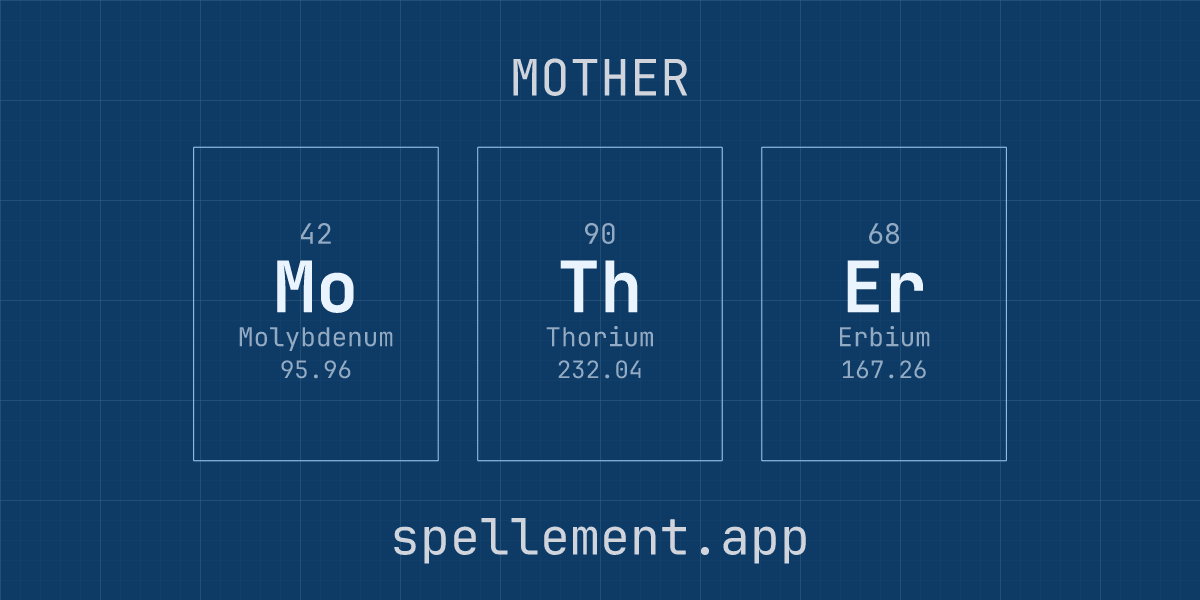
- IRIS, ROSE, LILY — clean, compact spellings that look great as prints or on mugs
- Mother's Day is coming (May) — a periodic table spelling of mum's name or her favourite flower is a unique, personal gift
- Teacher appreciation gifts — spring is when these peak
Head to the Spell tool, type any name or spring word, customize the colours, and export as a high-resolution image. It's free for words up to 7 characters — the Pro plan unlocks longer words up to 30 characters, plus high-res exports.
Try It
Type any spring word into the Spell tool and see it broken down into periodic table elements. BLOOM, SPRING, FERN, RAIN — they're all waiting.
Or browse 925+ spellable names and 400+ spellable things to see what else the periodic table has been hiding.
Spring is chemistry. The periodic table has been ready for it all winter.