Can You Spell SCIENCE with the Periodic Table?
Quick Answer
Strictly — using only whole element symbols — no, you cannot spell SCIENCE. One letter blocks it, and it's not the one most people guess. With partial emphasis, yes: SCIENCE spells as S · C · I · Eu · N · Ce — Sulfur, Carbon, Iodine, Europium (lending its E), Nitrogen, and Cerium.
And if you're here for the classic quiz question — "which word can be spelled in full by combining chemical symbols from the periodic table?" — the verified answers are below.
Can You Spell SCIENCE Using Only Whole Element Symbols?
Walk through the letters: S-C-I-E-N-C-E.
The opening is easy. S is Sulfur, C is Carbon, I is Iodine — three single-letter symbols in a row. The ending works too: the final C-E pair is exactly Ce, Cerium, a perfect two-letter match.
The problem is the fourth letter: the lone E in the middle. There is no element with the symbol E. The letter E only appears at the start of three two-letter symbols — Erbium (Er), Einsteinium (Es), and Europium (Eu) — and none of them fits here, because the letter after the E in SCIENCE is N, and "En" is not an element. The letter before it doesn't help either: "Ie" isn't a symbol.
So the strict answer is no. One unpaired E, and the whole word collapses. If a quiz asks whether SCIENCE can be spelled in full by combining chemical symbols, the correct answer is that it cannot.
The Trick That Makes SCIENCE Spellable
This is exactly what partial emphasis was made for. Instead of demanding a whole symbol for every letter, partial emphasis borrows one letter from a two-letter symbol — the borrowed letter is displayed emphasized, the other letter fades back.
For SCIENCE, Europium (Eu) lends its E:
S (Sulfur) · C (Carbon) · I (Iodine) · Eu (Europium, E emphasized) · N (Nitrogen) · Ce (Cerium)
Six element tiles, one borrowed letter, and the word every science teacher wants on a classroom poster. See SCIENCE spelled out in the tool — it renders the emphasis automatically and lets you download the result.
Can You Spell CHEMISTRY with the Periodic Table?
Here's the delightful part: CHEMISTRY contains Helium. The H-E pair in C-HE-M-I-S-T-R-Y is a perfect full-symbol match — the science of elements has an element sitting in its own name.
But strictly, CHEMISTRY fails anyway, and the culprit is M. No element has the symbol M — like E, it only opens two-letter symbols (Mg, Mn, Mo, Mt), and "Mi" is not an element. With partial emphasis, though, CHEMISTRY spells beautifully:
C (Carbon) · He (Helium) · Mg (Magnesium, M emphasized) · I (Iodine) · S (Sulfur) · Ti (Titanium, T emphasized) · Rb (Rubidium, R emphasized) · Y (Yttrium)
And PHYSICS?
The twist nobody expects: PHYSICS is the easiest of the three. Every single letter is its own element symbol — no pairs, no borrowing, no tricks:
P (Phosphorus) · H (Hydrogen) · Y (Yttrium) · S (Sulfur) · I (Iodine) · C (Carbon) · S (Sulfur)
Of the three classic school sciences, PHYSICS is the only one that spells in full with whole symbols. Chemistry can't spell itself, but physics can — a fact guaranteed to start an argument in any staff room.
Which Word CAN Be Spelled in Full by Combining Chemical Symbols?
This question shows up on quizzes, homework sheets, and trivia nights constantly, usually with multiple-choice options. Here are verified words that work with whole symbols only — no partial emphasis needed:
- SWAG — S (Sulfur) + W (Tungsten) + Ag (Silver)
- CUTE — C (Carbon) + U (Uranium) + Te (Tellurium)
- BASE — Ba (Barium) + Se (Selenium)
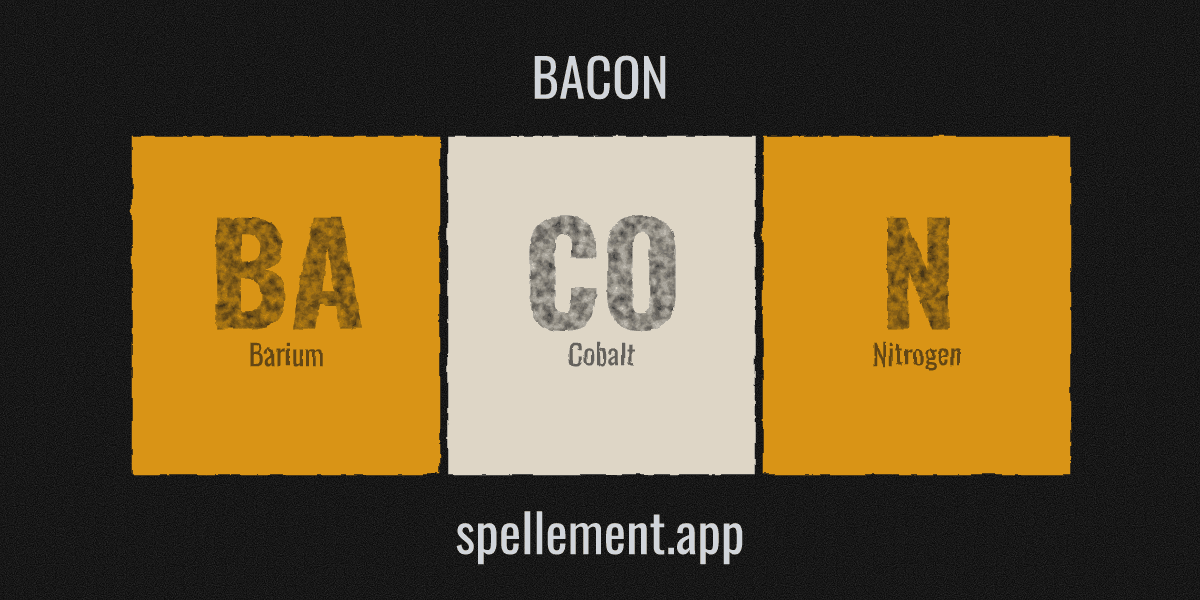
- BACON — B (Boron) + Ac (Actinium) + O (Oxygen) + N (Nitrogen)
- GENIUS — Ge (Germanium) + N + I + U + S
- NEON — Ne (Neon) + O (Oxygen) + N (Nitrogen)
- IRON — Ir (Iridium) + O + N (yes, you can spell iron without using iron)
- CANDY — Ca (Calcium) + N (Nitrogen) + Dy (Dysprosium)
- TEACHER — Te (Tellurium) + Ac (Actinium) + H (Hydrogen) + Er (Erbium)
- WATER — W (Tungsten) + At (Astatine) + Er (Erbium)
- FIRE — F (Fluorine) + I (Iodine) + Re (Rhenium)
- NUCLEUS — N + U + Cl (Chlorine) + Eu (Europium) + S
If your quiz offers several words and asks which one works, the method is simple: first scan for J or Q (instant disqualification), then check whether the letters split cleanly into real symbols. Or skip the pencil work and type each option into the spell tool — it finds every valid combination instantly. TEACHER even has its own page with the full element breakdown.
Can You Spell THANK YOU? HAPPY BIRTHDAY?
Both — with partial emphasis doing some lifting. THANK YOU uses Thorium (Th), Aluminum (Al, A emphasized), Nitrogen, Potassium, then a pure Y-O-U from Yttrium, Oxygen, and Uranium. HAPPY BIRTHDAY works too, tile by tile — a chemistry-themed card waiting to happen.
Which Words Can't Be Spelled At All?
Some words are beyond saving, and it always comes down to the same two letters:
- QUIZ — The letter Q appears in no element symbol, which means the word "quiz" itself can never be spelled with elements. The periodic table cannot spell the very format this question arrives in.
- JAZZ — The letter J is the other total absence; no symbol has ever contained it.
J and Q are the only letters missing from the entire periodic table — every other letter appears somewhere. The full story of why is in J and Q: The Two Letters the Periodic Table Forgot.
Try It Yourself
Whether it's a homework question, a quiz night tiebreaker, or a word you just want on a poster, the fastest way to check any word is to type it into the Spell tool. It applies whole-symbol matches first, falls back to partial emphasis where needed, and shows every valid combination ranked. For more verified words — over 800 of them, organized by category — see the full spellable words list.